
Your lower back has been sending signals for months. Maybe it started as a dull ache that came and went, then became something you could not sleep through. You’ve been told you have a herniated disc at L4-L5, and now you’re trying to figure out what that actually means, what’s causing your symptoms, and whether surgery is truly your only path forward.
After over 30 years performing spine surgery and completing over 2,700 Deuk Laser Disc Repair® procedures, I’ve seen this exact scenario thousands of times. The L4-L5 level is the most common source of disc-related back pain in the entire spine. Understanding what’s happening at that level, and why, is the first step toward making a real decision about your care.
No cost · No obligation
Live Pain Free
Upload your MRI for a free expert review by Dr. Ara Deukmedjian, M.D. — board-certified neurosurgeon. Ten minutes can change your life.
What Is a Herniated Disc at L4-L5?
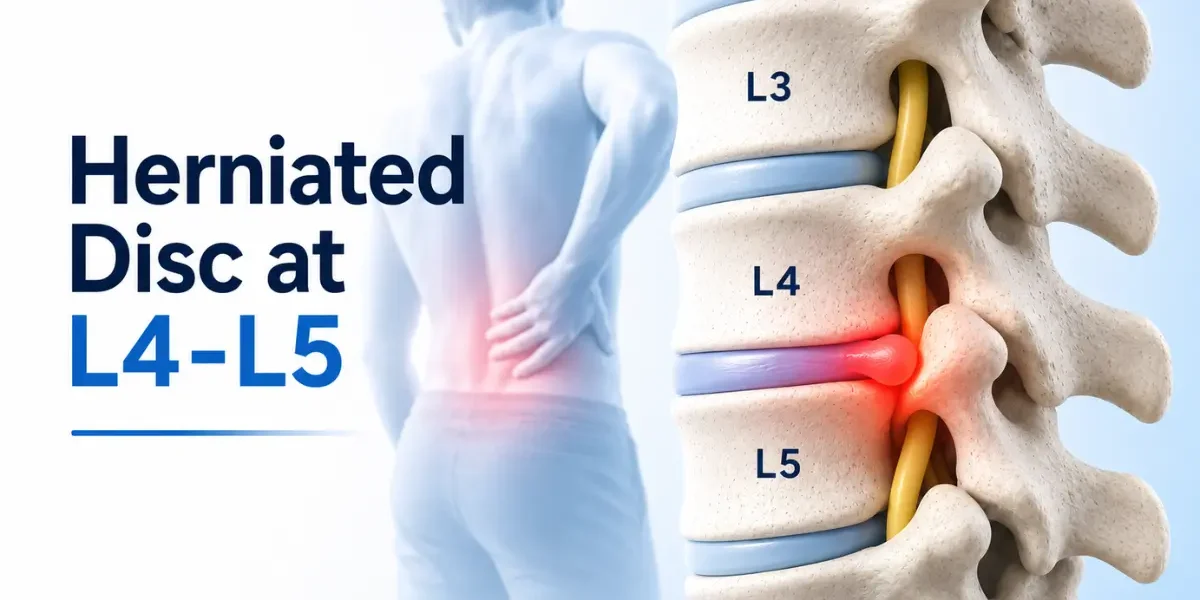
The lumbar spine, your lower back, consists of five vertebrae stacked on top of one another. Between each vertebra sits a spinal disc, a structure with a tough outer shell called the annulus fibrosus and a soft, gel-like center called the nucleus pulposus. These discs absorb shock, distribute load, and allow your spine to move in multiple directions.
At L4-L5, the disc sits between the fourth and fifth lumbar vertebrae. This is the most mechanically stressed segment in the lower back. It handles the combined forces of body weight, rotation, and bending across your entire upper body. Over time, or after an acute injury, the annulus fibrosus can develop a tear, usually in the posterior portion, the back wall of the disc. When the nucleus pulposus pushes through or into that tear, the result is what imaging reports call a herniated disc.
The term herniated disc actually encompasses a range of findings that radiologists and physicians describe using different names. All of the following refer to essentially the same category of disc pathology:
- Disc herniation – nucleus pulposus material has displaced beyond its normal boundary
- Disc bulge or bulging disc – the outer annulus extends beyond the disc margins without full rupture
- Disc protrusion – herniated material remains partially connected to the disc
- Disc extrusion – the herniated fragment has broken through the outer annulus
- Degenerative disc disease – chronic disc degeneration often accompanied by herniation
- Slipped disc – a colloquial term for the same condition
One thing is critical to understand about L4-L5 disc findings: the presence of a herniation on MRI does not automatically mean that disc is causing your pain. Research by Jensen et al. published in the New England Journal of Medicine found that 64% of asymptomatic adults with no back pain had disc abnormalities on MRI. What matters is whether that disc herniation is the actual structural source of your symptoms, and identifying that requires clinical skill, not just imaging.
The Real Source of L4-L5 Disc Pain
The pain from an L4-L5 herniated disc does not come from the herniation itself pressing down like a finger on a nerve. The primary source is inflammation. When the posterior annular tear forms and nucleus pulposus material becomes trapped in or around that tear, it triggers an inflammatory response that can persist for months or years.
That ongoing inflammation does two damaging things. First, it directly sensitizes the pain fibers already present in the outer annulus. Second, over time it causes small pain nerve fibers to grow into the inflamed tissue, a process called neoinnervation, which progressively amplifies the pain signal. The result is chronic axial back pain that does not resolve with rest, anti-inflammatories, or physical therapy because the structural source of the inflammation is still present.
This is why approximately 85% of chronic back pain, based on clinical experience with over 250,000 patients treated at Deuk Spine Institute, originates from disc injuries. The L4-L5 level is the most common culprit.
L4-L5 Disc Herniation Symptoms
The symptoms of an L4-L5 herniated disc fall into two distinct categories that are important to understand separately. Confusing them leads to misdiagnosis, and misdiagnosis leads to treatments that fail to address what is actually happening.
Axial Back Pain
Axial pain stays localized to the lower back. It does not travel into the leg. It originates from the disc itself, the surrounding ligaments, and the pain-sensitive structures within and around the posterior annular tear. Axial L4-L5 disc pain typically presents as:
- Chronic aching in the lower back – often described as deep, dull, and ongoing
- Pain that worsens with prolonged sitting – intradiscal pressure increases significantly in a seated position
- Pain that increases with bending or twisting – movements that load the posterior disc are provocative
- Morning stiffness – the inflamed disc is less mobile after overnight rest
- Relief with walking or lying flat – positions that reduce posterior disc loading provide temporary relief
This type of pain is driven by the inflammatory process at the annular tear, not by nerve compression. Anti-inflammatory medications reduce it temporarily, but they do not eliminate the structural problem producing the inflammation.
Radicular Symptoms
When a herniated disc at L4-L5 causes nerve-related symptoms, they are fundamentally different from axial back pain. Radicular symptoms travel along the path of the nerve being affected, and they are primarily driven by chemical inflammation irritating the nerve root, not mechanical compression alone.
L4-L5 disc herniations most commonly affect the L5 nerve root. Symptoms associated with L5 nerve involvement include:
- Shooting or electric pain radiating down the outer thigh into the shin – following the L5 dermatome
- Numbness or tingling along the same path – sensory fiber involvement
- Weakness in foot dorsiflexion – difficulty lifting the front of the foot
- Pain that worsens with coughing, sneezing, or straining – activities that briefly increase nerve root pressure
This is an important distinction: nerve compression from the herniation causes leg symptoms, not back pain. If you have both back pain and leg symptoms, those may be two separate problems at the same disc level requiring separate evaluation. Treating only the nerve-related component will not resolve the axial disc pain.
What Causes the Herniation
L4-L5 herniations develop through a combination of mechanical load and tissue degradation. Contributing factors include:
- Repetitive loading and microtrauma – accumulated stress over years of bending, lifting, and sitting
- Acute injury – a sudden high-load event that exceeds the annulus’s tolerance
- Age-related disc dehydration – the nucleus pulposus loses water content, reducing its ability to distribute force evenly
- Postural and movement patterns – these are compensatory responses to underlying structural problems, not primary causes
Poor posture and weak core muscles are frequently cited as causes of disc herniations, but this is not accurate. Postural changes are typically the body’s response to pain, not its origin. The spine shifts to reduce load on the painful structure. Physical therapy can support recovery when structural damage is minimal, but it cannot repair an annular tear or eliminate the inflammation driving chronic disc pain.
How Is an L4-L5 Disc Herniation Diagnosed?
Accurate diagnosis of an L4-L5 herniated disc, and specifically confirming that disc as the source of a patient’s pain, requires more than reviewing an MRI report.
The Deuk Spine Exam® combines three elements to achieve 99% diagnostic accuracy:
- MRI analysis – identifying structural pathology, the location and nature of the tear and herniation
- Physical examination – neurological testing, provocative maneuvers, and functional assessment
- Clinical history – the pattern, duration, and character of symptoms over time
This integrated approach identifies which structural finding is actually responsible for the patient’s specific symptom pattern. That distinction changes everything about treatment planning. A disc visible on MRI is not automatically a painful disc. Treating the wrong level, or treating nerve symptoms without addressing the disc tear causing axial pain, explains why so many patients continue to suffer after conservative care and even after some surgical procedures.
L4-L5 Treatment Without Surgery: What Actually Works
Before discussing surgical options, it is worth being direct about what conservative treatment can and cannot accomplish for an L4-L5 herniated disc.
Conservative approaches work best when a disc herniation is causing temporary nerve irritation with minimal annular disruption. In those cases, the body’s natural healing response can reduce inflammation over several months. The following approaches have legitimate roles in that context:
- Activity modification – reducing movements that directly provoke symptoms while the acute phase resolves
- Physical therapy – can help with muscle conditioning and symptom management, but does not repair disc tears
- Epidural steroid injections – reduce nerve inflammation and can provide meaningful temporary relief for radicular symptoms
- Oral anti-inflammatory medications – reduce systemic inflammation but do not address structural disc pathology
The honest limitation of conservative L4-L5 treatment is this: none of these options address the posterior annular tear that is producing chronic inflammation. If your pain has persisted beyond three to six months despite consistent conservative care, it is very likely that a structural source, specifically the disc tear and associated inflammation, is driving your symptoms. In that situation, continued conservative treatment is unlikely to resolve the problem.
Deuk Laser Disc Repair® for L4-L5 Herniation
Deuk Laser Disc Repair® is a minimally invasive outpatient procedure that directly treats the posterior annular tear and the inflammatory tissue surrounding the herniation. It is the only procedure I am aware of in the published spine literature that specifically targets the annular tear as the source of disc pain, rather than removing disc material or stabilizing the spine through fusion.
The procedure works by accessing the disc through a small incision, approximately 4 to 7 mm, smaller than a dime. Using laser and endoscopic technology, the inflamed tissue within the posterior annular tear is removed through a process called debridement, and the herniated nucleus pulposus material contributing to that inflammation is addressed at the same time. The tear is not sealed with foreign material. Instead, it is prepared to heal naturally over the following nine to twelve months, without cadaver bone, metal hardware, or plastic implants of any kind.
The distinction from traditional spine surgery is significant:
- No bone drilling – traditional discectomy and fusion require removing bone to access the disc, disrupting spinal stability
- Motion preservation – the treated segment retains its full range of motion, unlike fusion which permanently eliminates movement at that level
- Same-day outpatient procedure – approximately 20 minutes per disc level, with patients walking within hours
- No opioid requirement post-operatively – the procedure’s targeted approach eliminates the need for heavy post-surgical pain management
- No prolonged recovery – return to normal activity in days to weeks, not the months required after fusion
In my clinical experience with over 2,700 Deuk Laser Disc Repair® procedures at L4-L5 and other lumbar levels, patients report an average of 99% pain relief for treated pain sources, with a complication rate of 0.01%. These outcomes reflect what becomes possible when a procedure directly treats the structural source of pain rather than managing symptoms or trading disc mobility for stabilization through hardware.
Why Fusion Is Not the First Answer for L4-L5
Lumbar fusion at L4-L5 is one of the most commonly performed spine surgeries in the United States. It removes the disc, places bone graft between the vertebrae, and uses rods and screws to lock that segment in place permanently. For certain cases involving significant instability or deformity, it is an appropriate procedure. For the majority of patients with a herniated disc at L4-L5 producing axial back pain, it is a far more aggressive intervention than the underlying problem requires.
Fusion eliminates motion at L4-L5, which transfers mechanical stress to the adjacent levels, most commonly L3-L4 above and L5-S1 below. This is documented in the spine literature as adjacent segment disease, and it is a recognized reason why some patients require additional surgeries after fusion. A motion-preserving approach that treats the actual pain source avoids this problem entirely.
If you have been told that fusion is your only option for L4-L5 disc pain, a second opinion based on your MRI is worth obtaining before proceeding.
Take the Next Step
An L4-L5 herniated disc does not have to mean years of managed pain, progressive limitation, or an irreversible procedure. The path forward starts with an accurate diagnosis that confirms the disc is actually the source of your symptoms, and understanding whether a motion-preserving treatment can address that source without fusion.
Deuk Spine Institute offers a free MRI review to help patients understand what their imaging actually shows and whether Deuk Laser Disc Repair® is an appropriate option for their specific condition. There is no obligation, and the review is completed by an experienced clinical team that has evaluated over 3,000 MRI studies for exactly this purpose.
If chronic L4-L5 back pain has been limiting your life, start with the information you need to make a real decision. Request your free MRI review at Deuk Spine Institute.

Diagnosis. Answers. Relief.
Submit your MRI for a free expert review by Dr. Ara Deukmedjian, M.D. — board-certified neurosurgeon. No obligation. Real answers.
Schedule Yours Today